“Forever chemicals” — PFAS — have gone from a niche worry to a national headline. If you’re wondering whether they’re in your tap water and whether a filter helps, here’s a calm, research-based summary of where the UK actually stands in 2026, and what (if anything) to do about it.
What are PFAS?
PFAS (per- and polyfluoroalkyl substances) are a family of thousands of synthetic chemicals used since the 1950s in non-stick pans, waterproof clothing, food packaging and firefighting foam. They’re called “forever chemicals” because they break down extremely slowly and accumulate in the environment — and in us. That persistence is exactly why they’ve become a regulatory focus.
The UK position in 2026
Two things are true at once, and it’s important to hold both:
-
UK tap water is regulated and, by current standards, generally safe. As of March 2025, the Drinking Water Inspectorate (DWI) requires water companies in England and Wales to enforce a cumulative limit of 100 nanograms per litre (ng/l) across 48 PFAS — stricter than the previous per-substance approach, and broader than the EU’s and Scotland’s 20-substance rule. A 2026 Imperial College London survey of London tap water found PFAS within current safety limits.
-
Some scientists argue the limits should be tougher. The Royal Society of Chemistry’s #CleanUpPFAS campaign has called for a statutory limit of just 10 ng/l per single PFAS — ten times stricter than the current cumulative guideline. So “within the limit” and “as low as some experts would like” are not the same thing.
In short: you don’t need to panic, but if you’d personally prefer your drinking water to contain as little PFAS as possible, that’s a reasonable choice — and it’s achievable at home.
Do water filters remove PFAS?
Not all of them. This is where the type of filter matters enormously:
- Reverse osmosis (RO) — the most effective common home method. RO membranes block the large majority of PFAS molecules. Look for explicit certification.
- High-quality activated carbon — can reduce some PFAS, but performance varies widely and drops as the filter ages.
- Standard jug filters — generally not designed or certified to remove PFAS meaningfully.
The key is independent certification, specifically NSF/ANSI P473 (for PFOA/PFOS) or NSF/ANSI 53/58 covering PFAS. Treat uncertified “removes PFAS” marketing claims with caution — verified beats claimed.
Our PFAS-reducing picks
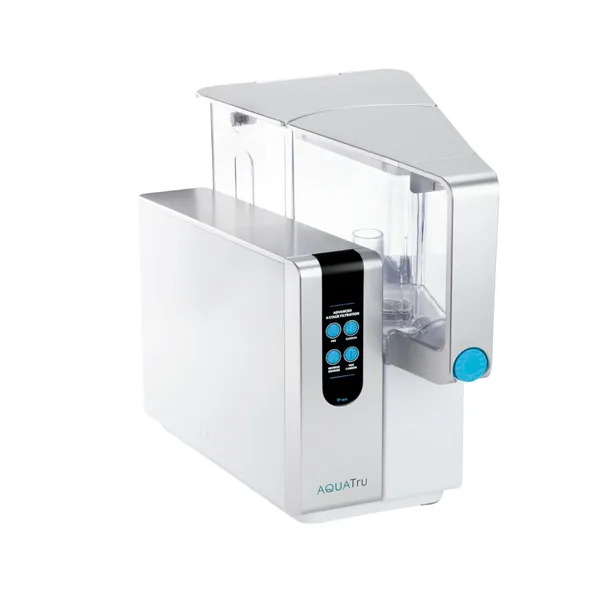
AquaTru Classic
Explicitly certified to NSF/ANSI P473 for PFOA/PFOS. Countertop, no plumbing — the most straightforward certified PFAS reduction for UK homes.
Read our AquaTru Classic review →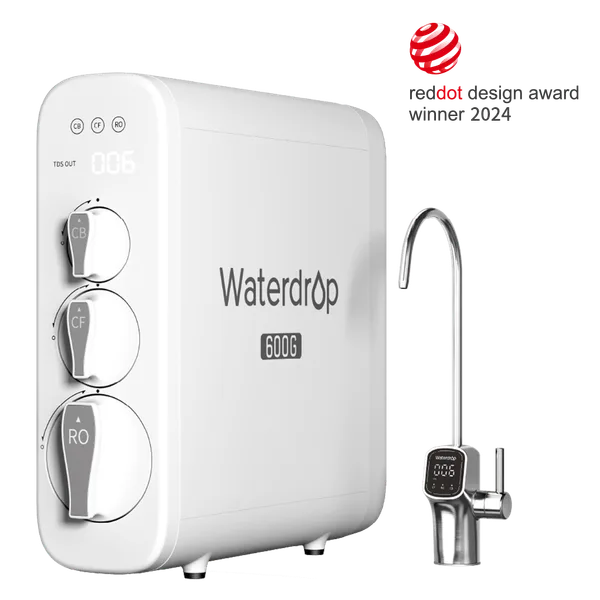
Waterdrop G3P600
Under-sink reverse osmosis that reduces PFAS along with hardness and lead. The pick if you own your home and want it plumbed in.
Read our Waterdrop G3P600 review →Should you actually buy one for PFAS?
Honestly? It’s optional, not urgent. UK water meets current regulatory limits, so a PFAS filter is a precautionary upgrade rather than a fix for an active problem. But if you’re buying a reverse-osmosis system anyway — for London’s hard water, for lead, or just for taste — then certified PFAS reduction comes along for free, which is a sensible reason to choose a well-certified RO model over a basic carbon filter. If your only concern is PFAS and your water already tests within limits, a certified countertop unit like the AquaTru is the simplest answer.
Frequently asked questions
Is there PFAS in UK tap water?
Trace PFAS is detectable in some UK supplies, but water companies must keep it within the DWI's limit of 100 ng/l cumulatively across 48 PFAS (since March 2025). A 2026 Imperial College London survey found London tap water within current safety limits.
Do water filters remove PFAS?
Reverse osmosis is the most effective common home method and reduces the large majority of PFAS. Some high-quality carbon filters help; standard jug filters generally don't. Look for NSF/ANSI P473 or 53/58 certification.
What is the UK PFAS limit in drinking water?
Since March 2025, the DWI requires water companies in England and Wales to keep PFAS within a cumulative 100 ng/l across 48 substances. The Royal Society of Chemistry has campaigned for a stricter 10 ng/l per single PFAS.
Which water filter is best for PFAS in the UK?
A reverse-osmosis system with explicit certification. The AquaTru Classic is certified to NSF/ANSI P473 specifically for PFOA/PFOS; the under-sink Waterdrop G3P600 also reduces PFAS as part of its RO filtration.
Do I really need a PFAS filter?
It's precautionary, not urgent — UK water meets current limits. But if you're buying reverse osmosis anyway for hard water or lead, certified PFAS reduction comes included, which is a good reason to choose a well-certified RO model.